
Singing Courtesans
One way women could pursue intellectual and artistic passions and perform publicly in 17th Century Venice

Imagine you are a young, male, tourist with money in your pocket in Venice in the 16th century. The Black Plague hasn’t happened yet, so you are enjoying yourself as much as possible. You’ll go to concerts, visit churches, look at art, and eat and drink a lot.
And most likely, you will get to know one of Venice’s top attractions at the time: the “honest courtesans,” that is, high-class prostitutes, avialable only to high-class gentleman such as yourself.
And how would you find them? Not in a 16th century red-light district. The courtesans were fairly scattered, though they clustered in high-traffic areas, close to the big tourist spots and the restaurants and cafes that served the same clientele. In order to find them all you needed was the guide, a printed book titled Il catalogo di tutte le principali et più honorate cortigiane di Venezia (“The Catalogue of All the Principal and Most Honored Courtesans of Venice.”). This was a list of two hundred and twelve courtesans, each identified by name, location, the name of their go-between, (often their mothers) and the price range for their services. Hannah Johnston, a Ph.D. student at Stanford, has translated the catalogue to English. You can find her article and a link to her translation here and her interactive map of courtesans over a map of Venice here. The image of a partial page below is from her translation.
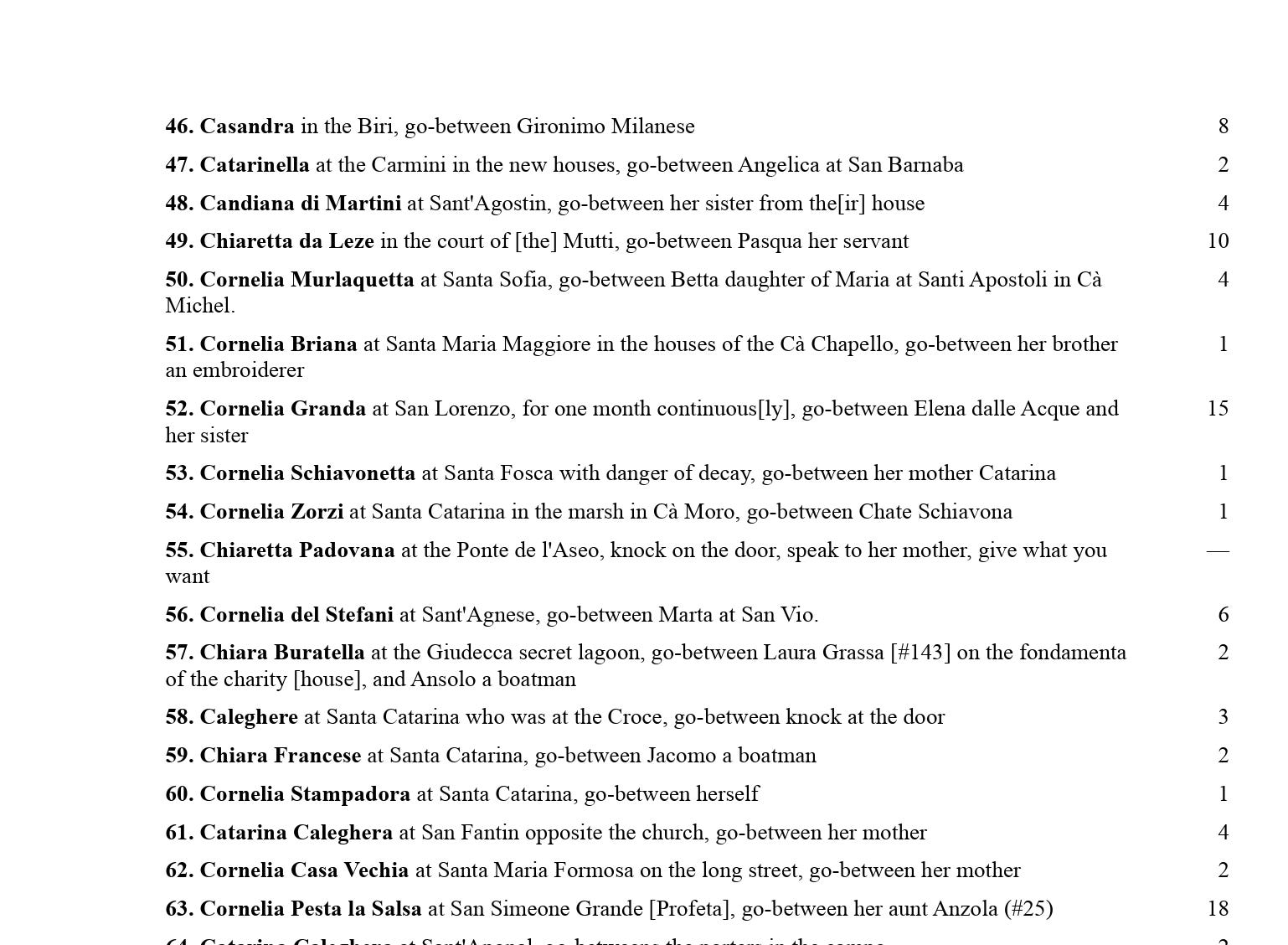
The video below shows images of high class courtesans from various paintings and re-affirms their high status. Traditional women were severely socially restricted, with few freedoms. Few of these rules applied to high-class courtesans, who were independent, dressed provocatively and socialized with the most powerful, influential, and educated men of their world. In order to maintain the fascination of their clients they needed to be highly educated themselves in literature and the arts. And they needed to know how to entertain. That included being able to improvise poetry and of course, make music.
There are many paintings of the era depicting beautiful women playing music, especially playing the lute. Laura Ventura Nieto points out that not all of these images are of high-class courtesans. Though after studying dozens of them it seems clear that if the musician’s breast is exposed she probably is.
We know the names of a few of these artistic courtesans, though some cases, such as Barbara Strozzi’s, are disputed. You can read Strozzi’s Wikipedia page here. The picture below is from that page:
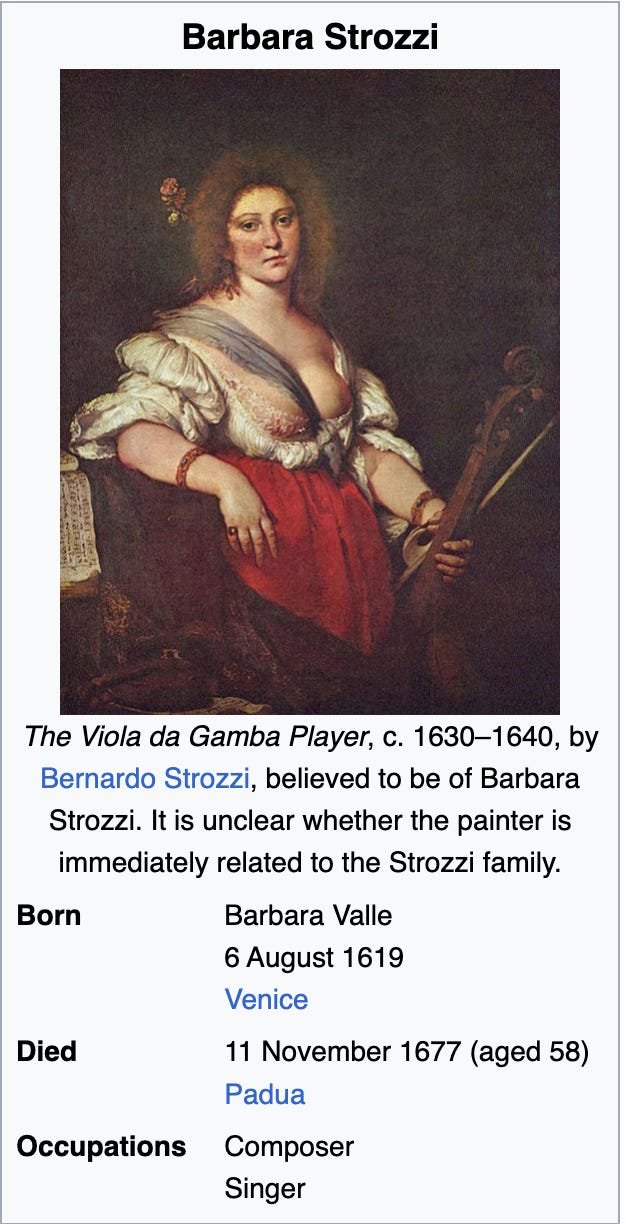
Strozzi lived during the time my novel, Trees Long For Rain, is set, and what little we know about her partly inspired my character of Margharita. However, unlike Margharita, Strozzi was probably coerced to be the concubine of a business associate of her father’s, a man named Vidman. She had multiple children with him but they never married.
Veronica Franco was the daughter of an honest courtesan, who initiated her into the arts of the profession when she was very young. She did try marriage but it didn’t work out, so she and her mother returned to the profession. VisitVenezia.eu tells her story as follows:
Around the age of 16, she got married with a doctor, Paolo Panizza. The union was financially beneficial for her, but soon, the man turned out to be an alcoholic gambler, pretty violent towards his wife. So, after a while, Veronica Franco left his partner behind and moved back to her mother’s house, exactly when she gave birth to Achilletto, first of her six children, who all probably died prematurely. The two women started to both live and work together. A proof of this can be found in the “Catalogo de tutte le principal et più honorate cortigiane di Venetia”, published in 1565, the catalogue listing all the honest courtesans of the city, with their addresses and prices. Veronica’s name was written together with Paola, and their price was the same, 2 ecus per night. Nevertheless, after some time, she became so desirable that just a kiss cost 5 ecus and her company was worth 50.
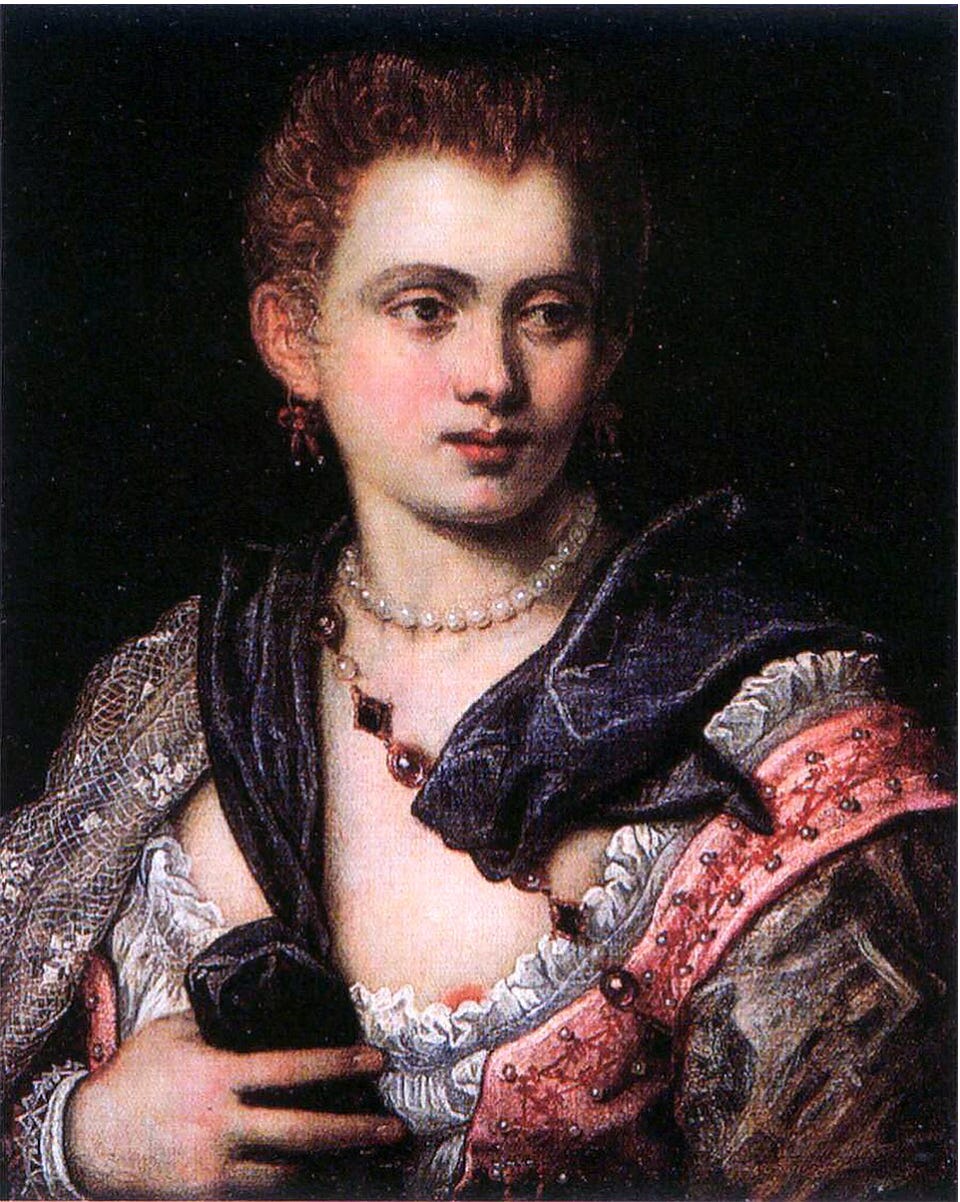
Jacopo Tintoretto or Follower. Portrait of a lady. 16th century. Worcester Art museum, Massachusetts
A portrait, said to be of Veronica Franco, was acquired by the Worcester Art Museum from a private collection in Venice in 1948. On the lining of the painting, Franco’s name appears in block letters.
A number of women who were part of the courtesan culture of sixteenth and seventeenth-century Italy had relatively well-documented lives for the period, and surviving writings, portraits, and other artifacts tell us a lot about their musical practices. In some cases, their stories refer to unwritten music practices that were central to Renaissance music-making: Many composed and performed poetry, often to their own accompaniment on the lute, lira da braccio, or viol. Some played and improvised dance music and instrumental fantasies. Those who did engage with written music could be skilled chamber musicians, singing and playing polyphony from notation, or were even published composers.
Belt’s article includes a long list of music attributed to courtesans or dedicated to them. She describes Strozzi’s output:
Back in Venice, the virtuoso soprano and cortegiana Barbara Strozzi published 8 music collections between 1644 and 1664, mostly chamber cantatas for solo voice and basso continuo, occasionally with multiple voices and obbligato instruments. Two of her volumes are devoted to motets and spiritual arias.
Here is a video performance of a song by Barbara Strozzi (only the first song on the video)
All of this is just enough to tell us that courtesans have as much to teach us about intellectual passion as about physical passion. I look forward to reading the Feldman and Gordon book listed below and I’m searching for more about the literary output of courtesans. I’ll update here when I find out more!
Not everything was music and beautiful clothes for the courtesans. As Elizabeth Haigh points out in The Harrowingly True Life of a Venetian Courtesan, a courtesan’s life was subject to many dangers, from syphillis to pregnancy to legal persecution:
Although being a courtesan during the Renaissance allowed a woman relative independence – offering the opportunity to be financially autonomous and to have control of her own life, the long-term consequences of being a sex worker overshadowed these short-term benefits. If, despite the threats of syphilis, death during childbirth, or execution for practising witchcraft, a courtesan managed to live to an old age, her career would nonetheless have been short lived because their clients were only interested in youthful women. Hence, the wealthy lifestyle that courtesans are often associated with occupied only a short period of their lives, with the reality being that many courtesans died in impoverished circumstances, leaving them in an equally vulnerable state as other Venetian women.
The above shows how far women are willing to go against their system in order to obtain what we should all be entitled to: agency, access to financial independence, freedom to pursue knowledge, artistic creativity, and of course, music.
REFERENCES
History of the Venetian Courtesans, Shady Ladies Video, Youtube,
Laura Ventura Nieto, An alluring sight of music: the musical ‘courtesan’ in the Cinquecento, Early Music, Volume 51, Issue 1, February 2023, Pages 116–125, https://doi.org/10.1093/em/caac078
Tintoretto image, said to be of Veronica Franco, https://commons.wikimedia.org/wiki/File:VeronicaFranco.jpg
Veronica Franco: A Symbol of empowerment in the Venetian Renaissance
VisitVenezia.edu website
https://www.visitvenezia.eu/en/venetianity/tales-of-venice/veronica-franco-a-symbol-of-empowerment-in-the-venetian-renaissance
The Courtesan’s Arts: Cross-Cultural Perspectives PAP/CDR Edition
by Martha Feldman (Editor), Bonnie Gordon (Editor)
This book specifically looks closely at music in the lives of courtesans from all over the world, but most of the articles focus on Italy.
Chelsey Belt, Renaissance Women: The Music of Courtesans
https://www.ipm.org/show/harmonia/2023-02-27/renaissance-women-the-music-of-courtesans
The fourth track has lyrics by Veronica Franco:
Cosimo Bottegari (lutebook of 1574); Veronica Franco (text)
Tr. 6 “Bottegari’s tune for a terza rima sung with Veronica Franco’s ‘Non più parole’ (excerpt)” (1:06)
The fifth track of segment B features a song by Barbara Strozzi:
Barbara Strozzi: Che si può fare? ("What can one do?")
– Erica Schuller, soprano
The Harrowingly True Life of a Venetian Courtesan
by Elizabeth Haigh
I enjoyed this :)